
Artemis II: Journey Beyond Earth
The story of Artemis II is unfolding as one of the most significant milestones in modern space exploration. Led by NASA, this mission is the first time in over five decades that humans are traveling beyond low Earth orbit, echoing the legacy of Apollo 17. The core objective of Artemis II is not to land on the Moon, but to test all critical systems with a human crew onboard, ensuring that future missions can safely achieve lunar landings and eventually support long-term exploration.
At the heart of this mission is a diverse and international crew. The astronauts include Reid Wiseman, Victor Glover, and Christina Koch from the United States, along with Jeremy Hansen representing Canada. This makes Artemis II a symbol of global collaboration, with Hansen becoming the first Canadian to travel toward the Moon. Together, they represent not just individual nations but a shared human ambition to explore beyond Earth.

Photo credit-www.nasa.gov
The astronauts are traveling aboard the advanced Orion, launched using the powerful Space Launch System. Orion is designed for deep-space missions, equipped with advanced life-support systems, radiation protection, and the ability to sustain astronauts for extended durations. Its heat shield is one of the largest ever built, capable of withstanding the intense temperatures of re-entry into Earth’s atmosphere. Inside, the spacecraft supports communication systems that allow constant contact with mission control, even at vast distances from Earth. The path takes the spacecraft far beyond the lunar surface before gravity naturally guides it back toward Earth, ensuring safety even in case of propulsion issues.

Photo credit-www.nasa.gov
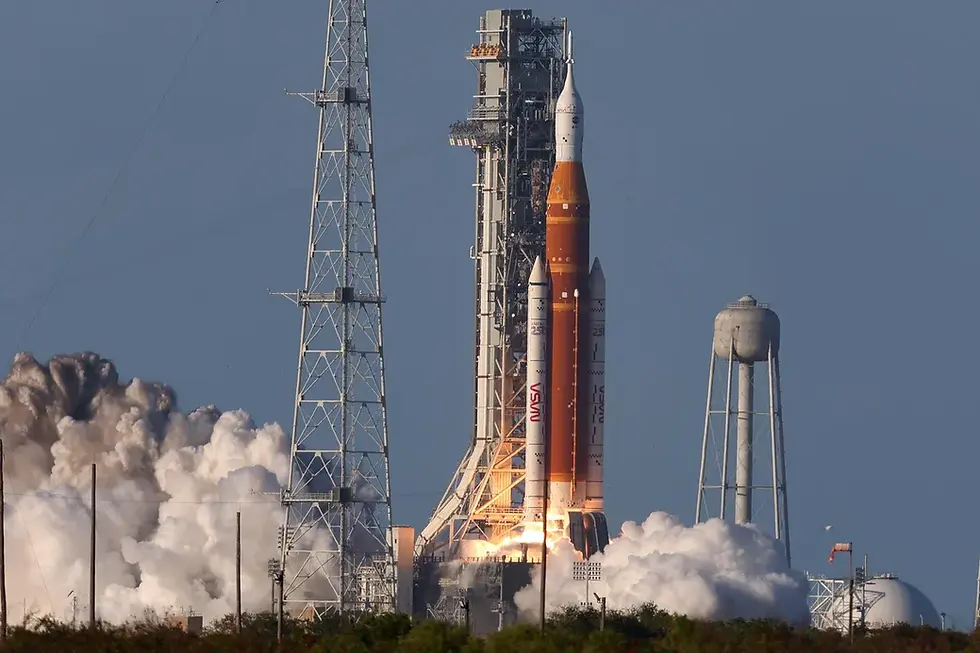
The Artemis II lifted off at 6:35 p.m. EDT on April 1 from Launch Pad 39B at Kennedy Space Center, beginning a remarkable journey in which the crew is expected to travel a total of 695,081 miles from launch to splashdown. During the mission, the spacecraft passes within 4,066 miles of the Moon’s surface at its closest approach and reaches a maximum distance of 252,757 miles from Earth, going about 4,102 miles farther than Apollo 13. The mission is scheduled to conclude with a splashdown off the coast of San Diego at approximately 8:07 p.m. EDT (5:07 p.m. PDT) on Friday, April 10, after which recovery teams retrieve the crew using helicopters and transport them to the USS John P. Murtha, where they undergo post-mission medical evaluations before returning to shore and flying back to Johnson Space Center.

Photo credit-www.nasa.gov
On Artemis II, astronauts are testing navigation and flight operations in deep space by performing maneuvers, monitoring how the spacecraft behaves far from Earth, and ensuring reliable long-distance communication with NASA; at the same time, they are studying the effects of deep space on the human body by collecting data on radiation exposure, microgravity, health, and performance, while also capturing images and observations of the Moon and Earth to improve understanding of spacecraft positioning, lighting conditions, and navigation accuracy for future missions.

Photo credit-www.nasa.gov
To conclude, Artemis II is like a full dress rehearsal for landing on the Moon. Every system, every movement, and every human response is being carefully studied so that the next missions can safely take astronauts to the lunar surface.


Comments