
Moving Data Centers and the Cloud into Orbit
At the heart of our digital world lies a symbiotic relationship between the cloud and the data center, though they are often mistakenly used as synonyms. While the cloud represents the virtual experience the seamless ability to store files and run applications from any device the data center is its physical reality. Think of the Cloud as the music you hear on your phone, and the Data Center as the huge speakers making the sound. Usually, those speakers are on the ground, but now we are putting them on satellites in space so they can play for the whole world at once. For example, NVIDIA has data centers that are the high-performance hubs where thousands of specialized GPUs work together to process the massive amounts of data required to train and run modern Artificial Intelligence.

Photo credit-resources.l-p.com
Another great example of a data center is a massive server farm like the one Google operates in The Dalles, Oregon. These are enormous, windowless warehouses packed with thousands of humming computers that store everything from your Gmail to YouTube videos. On Earth, these centers require giant cooling towers and millions of gallons of water to keep the hardware from melting. While the Cloud allows you to access your files instantly from your phone, the Data Center is that physical building in Oregon doing the heavy lifting. Now, we are starting to shrink that entire warehouse down into a satellite and launching it into orbit to use the natural cold of space instead of Oregon's water.

Photo credit- www.oregonlive.com
The primary driver for this orbital pivot is the sheer physics of space. On Earth, data centers are notorious for their environmental footprint, often consuming millions of gallons of water annually just to keep servers from melting down. In contrast, space offers a natural, infinite heat sink. By utilizing passive radiative cooling simply pointing heat shields away from the sun orbital centers can maintain optimal temperatures without a single drop of water or energy-intensive chilling systems.
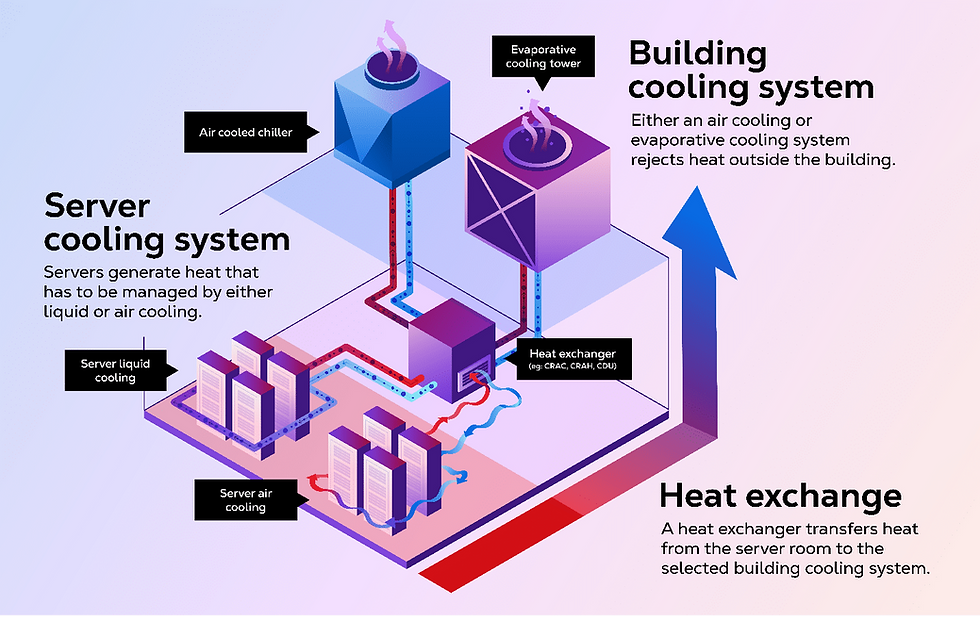
Photo credit-blog.equinix.com
Energy efficiency is the second pillar of this transition. Terrestrial solar panels are limited by the atmosphere, weather, and the inevitable cycle of night. However, satellites in a sun-synchronous "dawn-dusk" orbit can harvest unfiltered solar radiation 99% of the year. Recent data suggests these orbital arrays are up to five times more productive than their counterparts on the ground, providing a constant stream of clean, high-intensity power that bypasses our already strained global energy grids.

Photo credit- nvidianews.nvidia.com
Beyond the environment, there is a logistical "speed-to-market" advantage. Building a terrestrial data center campus currently takes five to eight years when factoring in land rights, utility negotiations, and environmental permits. Space-based infrastructure is shifting toward a modular, "assembly line" model. Companies like Axiom Space and SpaceX are proving that launching pre-configured compute nodes can bring massive capacity online in a fraction of the time it takes to break ground on a new facility in Texas or Virginia. Starcloud (formerly Lumen Orbit) has already launched NVIDIA H100 GPUs into orbit to train the world's first space-based AI models.

Photo credit- www.scientificamerican.com
As we look toward the remainder of 2026, we are entering a "hybrid cloud" era where the most intensive AI training and geospatial processing happen overhead. While we aren't abandoning ground-based servers yet, the "Orbital Pivot" represents a fundamental change in how we think about digital infrastructure. By moving our heaviest workloads into the stars, we aren't just scaling our technology; we are finally decoupling our digital growth from the limited resources of our home planet.
Until next time, stay safe and happy!!


Informative & exhaustive