
The Battle of Trafalgar
The Battle of Trafalgar was one of the most significant naval battles in European history. It took place on October 21, 1805, off the coast of Cape Trafalgar in southwestern Spain. The battle occurred during the wider conflict known as the Napoleonic Wars, when Napoleon Bonaparte sought to expand French power across Europe. The British Royal Navy, led by Admiral Horatio Nelson, faced a combined fleet of French and Spanish ships commanded by Admiral Pierre-Charles Villeneuve.

Photo credit-www.nmrn.org.uk
The main reason for the battle was Napoleon’s plan to invade Great Britain. To do this, he needed control of the sea and hoped the combined French and Spanish fleet would weaken the powerful British navy. However, Britain relied heavily on its naval strength to protect its island nation and trade routes. As the fleets encountered each other near Cape Trafalgar, both sides prepared for a decisive confrontation that would determine naval dominance.

Photo credit- www.thetrafalgarway.org
Admiral Nelson used an unusual and bold strategy during the battle. Instead of forming a traditional parallel battle line, he divided the British fleet into two columns and sailed directly into the enemy line. This tactic broke the formation of the opposing fleet and caused confusion among their ships. The British navy fought fiercely, demonstrating exceptional coordination and naval skill during the intense combat.

Although the British achieved a decisive victory, the battle came with a tragic loss. Admiral Nelson was shot by a sniper from a French ship during the fighting and died later that day aboard his flagship, the HMS Victory. Before his death, he learned that the British fleet had successfully defeated the enemy. His leadership and sacrifice made him a national hero in Britain.
The warships known as “ships of the line” were massive wooden vessels built mainly from strong oak and reinforced with thick timber frames to withstand heavy cannon fire. A typical first-rate warship like HMS Victory was about 69 meters (226 feet) long, weighed around 3,500 tons, and carried over 100 cannons arranged on multiple gun decks. Each cannon could weigh between 2 to 3 tons, and they fired heavy iron cannonballs that could weigh 24 to 32 pounds. Operating such a ship required a very large crew, usually around 800 to 850 sailors, soldiers, and officers, who handled navigation, sail control, gunnery, repairs, cooking, and medical care during long sea voyages and battles. These powerful ships, with their heavy artillery and large crews, formed the backbone of naval warfare in the early nineteenth century and played a decisive role in the victory at Trafalgar.

One of the large battle flags associated with the Battle of Trafalgar is preserved. Stretching an impressive 33 feet in width and 47.5 feet in length, the flag of the San Ildefonso (Spanish ship of the line) is an extraordinary historical artifact. Crafted from wool, it functioned as the ship’s battle ensign, designed on a massive scale so that it remained visible even through the thick clouds of smoke created by cannon fire. Its enormous size allowed both allies and opponents to clearly recognize the ship and its allegiance during the chaos of naval combat.
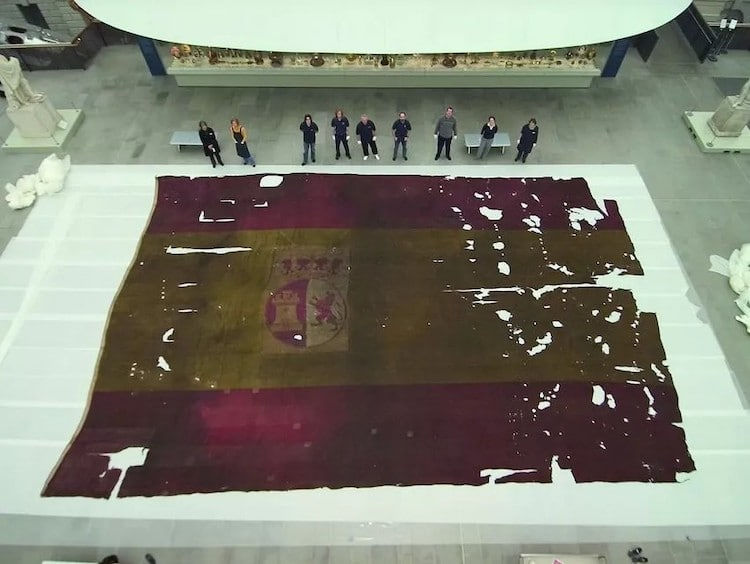
Photo credit-mymodernmet.com
The Battle of Trafalgar had long-lasting consequences for European history. The victory ensured British naval supremacy for more than a century and prevented Napoleon from invading Britain. It also weakened the naval power of France and Spain, changing the balance of power at sea. Today, the battle is remembered as a turning point in maritime history and as a symbol of courage, leadership, and strategic brilliance.


Comments